
The E-3 and L-3 tire patterns both fall under the category of "standard patterns" for off-road (OTR) tires designed for rocks and common road conditions. The main difference between them lies in their original design purposes: E-3 is specifically designed for heavy-duty transportation vehicles, while L-3 has been optimized for the working characteristics of equipment such as loaders. In practical applications, these two codes are often used in pairs as complementary or universal patterns.
Core comparison:
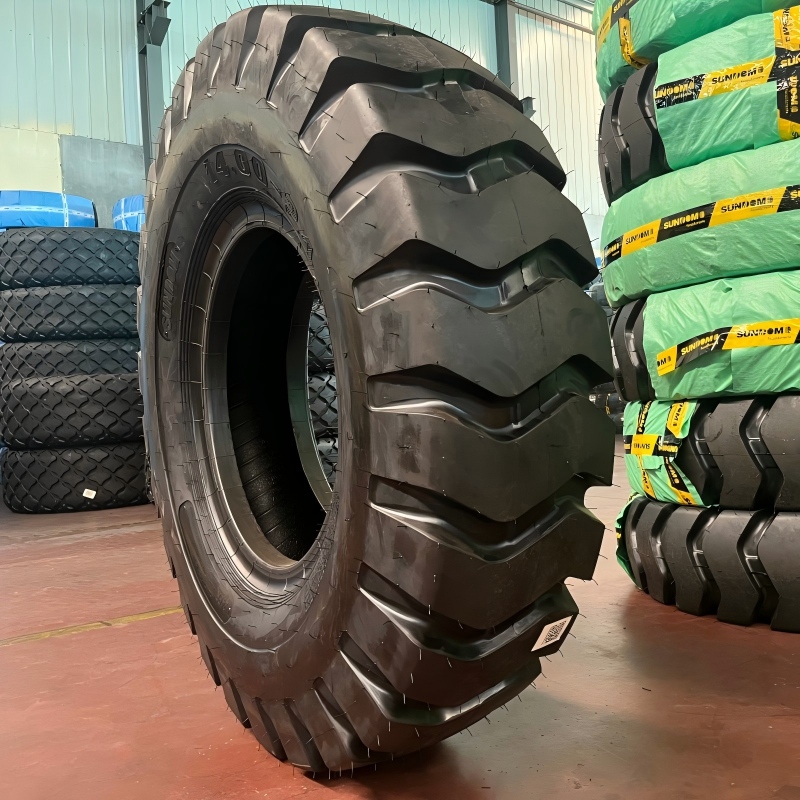
A. Designation and Equipment: In E-3, the "E" stands for "Earthmoving" (earthmoving and transportation), and it is mainly used in heavy trucks and articulated dump trucks; in L-3, the "L" stands for "Loader" (loader, bulldozer), and it is mainly used for loaders, bulldozers and scraper excavators.
B. Performance emphasis and features: The E-3 model focuses on linear wear resistance and transportation efficiency, with a wear-resistant and cut-resistant tread, and the shoulders are usually smooth to reduce wear at high speeds; the L-3 model emphasizes strong grip and torsional resistance, with interlaced tread blocks, extremely strong driving force, and greater emphasis on self-cleaning properties, making it easier to clean up the site's dirt.
C. Specification and Load Capacity: The E-3 tires are typically larger in size and are used for heavy-duty trucks. The key difference lies in that, for the same specification, the extremely heavy load capacity (usually referring to the load at 10 km/h) of the L-3 tires is significantly higher than that of the E-3. For example, for the 16.00-25 specification, the load capacity of the E-3 is 6700 kg, while that of the L-3 is as high as 11500 kg; for the 26.5-25 specification, the load capacity of the E-3 is 10000 kg, while that of the L-3 can reach 15500 kg.
When you see an annotation like E-3/L-3 on the tire (with a slash in the middle), it indicates that this tire meets the performance standards of both E-3 and L-3 tread categories, and is a dual-purpose or universal design.
Simple understanding: This tire can be used both as E-3 (for earthmoving transportation) and as L-3 (for loaders). The purpose of the manufacturer in designing this mixed code is to enable a single tire to meet the core requirements of both working conditions:
A. When used as E-3: It has good linear wear resistance and is suitable for long-distance and high-speed transportation by dump trucks.
B. When used as L-3: It has stronger grip and torsional resistance, and is suitable for loaders that operate at low speeds, carry heavy loads, and frequently make turns.
Note: Although tires marked with E-3/L-3 can be used interchangeably in most scenarios, their load capacity is generally determined by the stricter standard (usually the L-3 standard). For example, for the 16.00-25 specification, the pure L-3 load capacity is 11,500kg, while the pure E-3 is 6,700kg. The load capacity of E-3/L-3 tires is often close to or equal to the level of L-3.
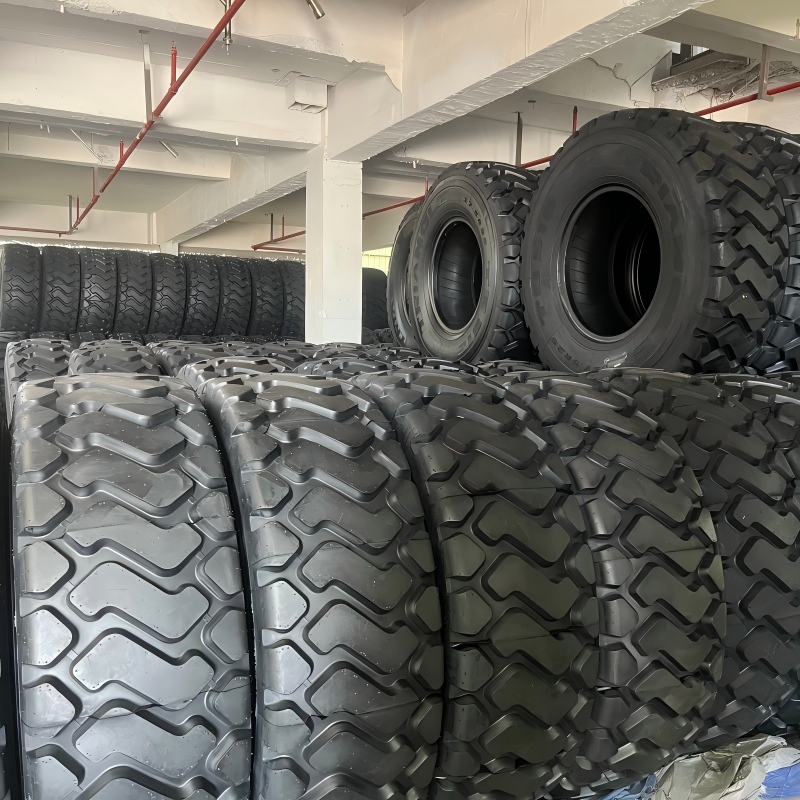
When making the actual purchase, if you see this code, it means you don't have to worry about having to choose between buying pure E-3 or pure L-3. It can basically cover the regular working range of both. However, if the equipment is extremely biased towards a certain working condition (such as pure high-speed transportation or extremely heavy-duty digging), choosing a specialized tread will be more optimal.
 Who is SUNDOM TYRE ?