
1. Tread Structure
- LUG (Lug / Traction Tread)
Features primarily transverse (lateral) grooves. The tread consists of large, robust, blocky lugs with sharp, aggressive edges.
- RIB (Rib / Highway Tread)
Features primarily longitudinal (circumferential) grooves. The tread is composed of continuous, straight ribs that run parallel to the tire’s rotation, creating a smoother, more uniform surface.
2. Core Performance Comparison
|
Aspect |
LUG Pattern |
RIB Pattern |
|
Traction/Grip |
Excellent, especially on soft/unpaved surfaces (mud, sand, gravel). |
Moderate. Relies on friction from continuous ribs. Prone to slipping on wet or loose terrain. |
|
Handing&Stability |
Fair. The blocky lugs tend to deform at speed, reducing straight-line stability. |
Excellent. The continuous ribs resist lateral movement, ensuring stable straight-line travel and responsive steering. |
|
Rolling Resistance/Fuel Efficiency |
High. The aggressive tread design increases rolling resistance, leading to higher fuel consumption and operating temperatures. |
Low. The smooth rib design minimizes rolling resistance, resulting in better fuel economy and cooler running temperatures. |
|
Noise Level |
High. The impact of lugs against the road generates significant tire noise, especially at higher speeds. |
Low. The continuous rib pattern produces less air turbulence and road noise for a quieter ride. |
|
Wear&Durability |
The thick, robust lugs are highly resistant to tearing and impacts, offering long life in harsh environments. |
The tread wears more evenly on smooth paved surfaces, offering excellent mileage. However, it is more susceptible to cuts and damage on rough terrain. |
3. Typical Applications
- LUG Pattern
Primarily used on agricultural vehicles, construction equipment, dump trucks, tractors, and trucks that frequently operate on construction sites, mines, or rough, unpaved roads.
Prioritizes superior traction, slip resistance, and durability over high-speed performance.
- RIB Pattern
Commonly found on steer axles, trailer axles, buses, and urban delivery trucks operating exclusively on paved roads (highways, city streets).
Prioritizes fuel efficiency, long mileage, stability, and low noise.
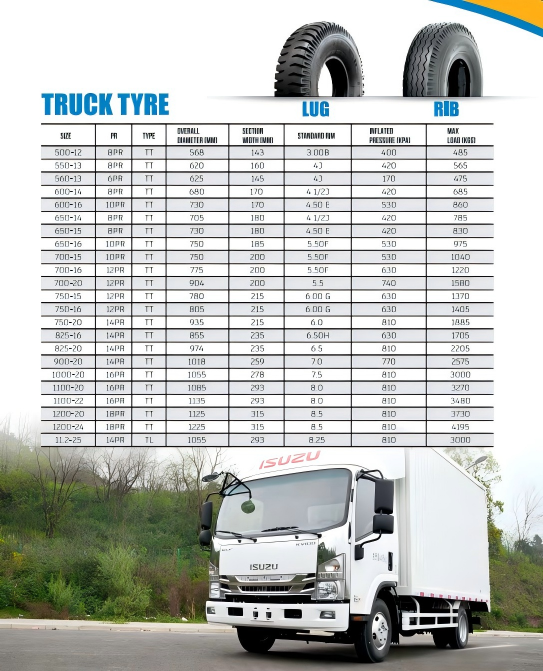
4. Quick Summary
- Choose LUG if the vehicle runs on rough roads and needs maximum traction, even at the cost of higher noise and fuel use.
- Choose RIB for highway use, where the priority is fuel efficiency, stability, and long service life.
 Who is SUNDOM TYRE ?